





4DOF motion simulators

technical specification
- operation conditions: normal dry indoor space
- ambient temperature: +10 ÷ +30°C (+50 ÷ +86°F)
- power voltage: 230 V AC ± 10% / 50 Hz
- maximum current: 16 A
- maximum (peak) consumption: 3,35 kW
- mean consumption (motion on): 1000 ÷ 1400 W
- mean consumption (motion off): 400 W
- leakage protected earth current: 7 mA typ., 20 mA max.
- maximum load (cockpit total): 300 kg (661 lbs)
- maximum load (person in the cockpit): 120 kg (265 lbs)
- overal weight: 350 kg (772 lbs)
- operation dimmensions L x W: 1620 x 1790 mm (63.8 x 70.5 in)
- transport dimmensions L x W: 1620 x 1380 mm (63.8 x 54.3 in)
- height (cockpit in bottom position): 1670 mm (65.7 in)
- maximum height (in motion): 2320 mm (91.3 in)
- minimum safety circle diameter: 2500 mm (98.4 in)
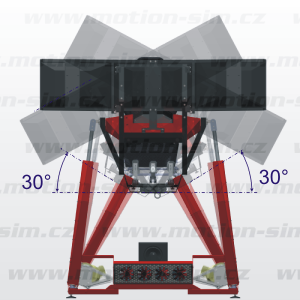
Roll ±29.9°, velocity 57°/s, acceleration up to 500°/s²
Roll ±29.9°
The motion system can tilt to the left and right up to 29.9 degrees from the neutral position. This simulates the rolling motion of a vehicle or aircraft.
Velocity 57°/s
This indicates that the roll can change at a speed of 57 degrees per second, which is the rate at which it can tilt.
Acceleration up to 500°/s²
The roll can accelerate up to 500 degrees per second squared, representing how quickly it can reach the desired tilt speed.
This ensures a responsive and realistic simulation experience, capturing rapid changes in motion.
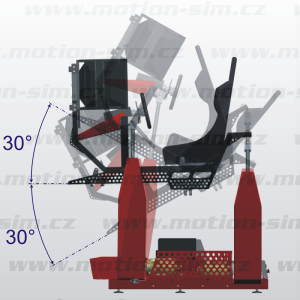
Pitch +31.4° / -31.1°, velocity 66°/s, acceleration up to 500°/s²
Pitch +31.4° / -31.1°
This indicates the simultor can tilt upwards by +31.4 degrees and downwards by -31.1 degrees from a neutral position. Pitch refers to the movement of the simulator's nose up or down.
Velocity 66°/s
The rate at which the pitch angle changes is 66 degrees per second, meaning how quickly the simulator can tilt up or down.
Acceleration up to 500°/s²
The acceleration of the pitch change can reach up to 500 degrees per second squared, indicating how quickly the simulator can achieve the specified pitch speed.
This description outlines the movement and speed capabilities of your simulator's pitch axis.

Yaw ±29.2°, velocity 65°/s, acceleration up to 500°/s²
Yaw ±29.2°
The simulator can rotate left and right by ±29.2 degrees from its neutral position. Yaw refers to the side-to-side movement of the simulator's nose.
Velocity 65°/s
The rate at which the yaw angle changes is 65 degrees per second. This means how quickly the simulator can pivot left or right.
Acceleration up to 500°/s²
The acceleration of the yaw change can reach up to 500 degrees per second squared, indicating how rapidly the simulator can achieve the specified yaw speed.
This description outlines the rotation and speed capabilities of your flight simulator's yaw axis.

Heave 480mm (18.9 in), velocity 435mm/s (17.1 in/s), acceleration up to 5 m/s² (16.4 ft/s²)
Heave 480mm (18.9 in)
This parameter indicates the vertical movement of the simulator up and down up to 480 mm (18.9 inches). Heave simulates the movement of the aircraft during ascent and descent.
Velocity 435mm/s (17.1 in/s)
The speed of vertical movement is 435 mm per second (17.1 inches per second), showing how quickly the simulator can move up and down.
Acceleration up to 5 m/s² (16.4 ft/s²)
The acceleration of vertical movement can reach up to 5 meters per second squared (16.4 feet per second squared), meaning how quickly the simulator can achieve the specified vertical movement speed.
This description outlines the vertical movement capabilities of your simulator.